Abate pears 400 g (I use an arbitrarily large amount of 3-4 pears… the more the merrier). They must be nicely ripe and soft. Cow’s milk ricotta 375 g (exact amount doesn’t matter) Flour 250 g Baking powder 16 g Medium eggs 3 (surprisingly, I made it without eggs in the past and it tastes very similar!) Sugar 140 g Lemon zest of 1/2 lemon Vanilla pod 1 or capful of vanilla essence
Preparation Start by cutting the pears in cubes around 1 by 1 cm. No need to be anal about size. Remember to remove the core. I personally don’t mind leaving the skin on. Place the cubes in a bowl with a small amount of lemon juice to prevent them from oxidising.
Beat the sugar with the ricotta with a whisk. Then add the seeds from the vanilla pod (or, more realistically, add a teaspoon of good-quality vanilla extract). Next, add the 3 eggs one by one, continuing to whisk the mixture. Add the grated lemon zest.
Sift the flour with the baking powder and add them to the mixture, mixing until a smooth dough forms. Incorporate the diced pears into the mixture.
Butter and flour a 24cm diameter springform cake pan well. Pour the cake mixture into the pan and level it using a spatula.
Bake the cake at 180°C (static oven) for 50/70 minutes, or until a wooden toothpick inserted into the center of the cake comes out dry. If the cake darkens too much on the surface during cooking, cover it with aluminum foil and/or pour a little bit of water at the bottom of the oven to produce some steam. I prefer it not dark on the top.
Remove the soft ricotta and pear cake from the oven, allow it to cool, then turn it out. Enjoy! As a dessert, it goes great served warm with a bit of vanilla ice-cream on the side. As an afternoon tea cake, have it at room temperature or cold on its own
PS: I recommend storing it in the fridge both for taste and durability.
This is a recipe close to my heart, as used to eat cecina every summer at Il Castagnacciao, Portoferraio (LI). The below recipe is taken and translated from this video by the great IlBocca, a cook from Livorno specialising in local recipes.
Ingredients
250g of besan or chickpea flour – get the best you can
10-15g of salt
1 shot of great extra virgin olive oil – Rosto mellow from Harris Farm if you are in Australia
750ml of water
Steps
Soak all the flour in all the water for at least 5 hours (the more time, the easier to digest it later). To mix them, start with a bowl, put the flour in, and then gradually pour the water in, mixing it with a whisk as you pour. Finally, add salt and mix. Cover it and let it rest on the kitchen bench (a fresh spot, but not in the fridge).
Further mix this resulting liquid dough every hour.
After 5 hours, add the olive oil and whisk.
Preheat your oven to the maximum temperature in static mode.
Grease up the tray you are going to use either with a heat-resistant oil, such as sunflower oil (safer choice), or with some more of the same e.v.o. oil you used before (riskier choice, as it might burn). The choice of the size of the tray should be made so that the liquid dough, once poured, will be about 0.5 cm thick.
Put the greased-up tray in the preheated oven for about 2-5 minutes, i.e. until the oil is hot (but before it starts smoking).
Now pour the liquid dough in.
Let it cook for about 25 minutes on static at maximum temperature.
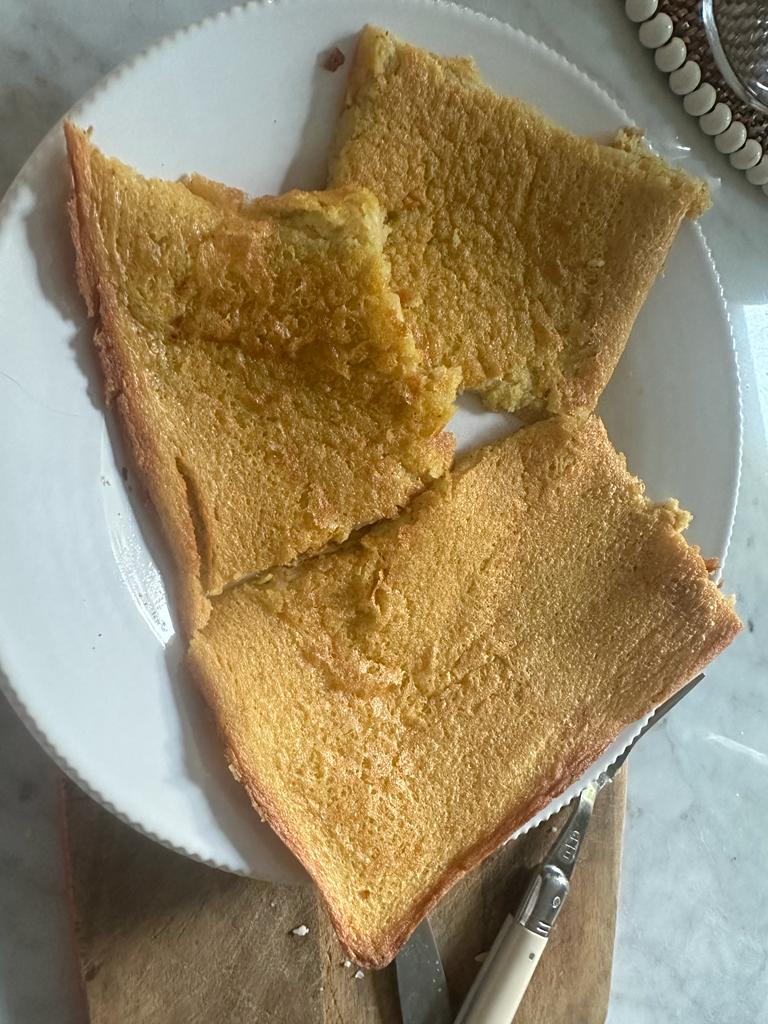
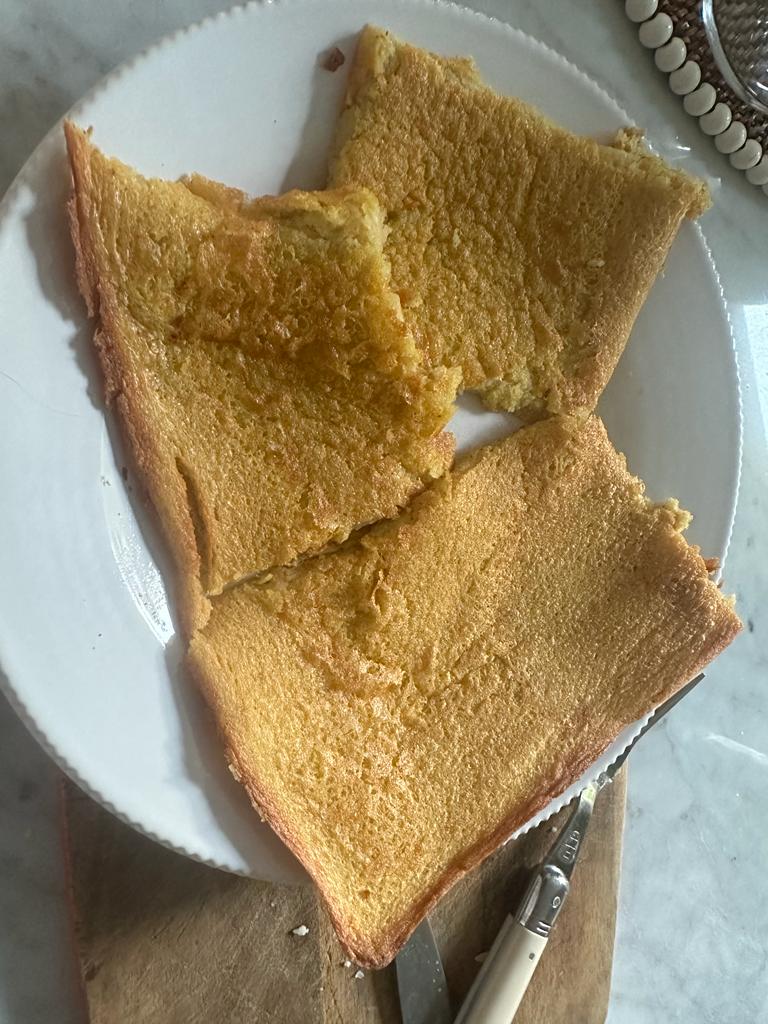
For the last 5-10 minutes put the oven on grill mode for a final browning touch. Don’t overdo it though, if the cecina already looks like in the picture, or even a bit darker, just take it out.
It is finally ready! Enjoy it, possibly with a generous amount of pepper on top.
Hey 3 readers, let me put down this short and hopefully effective blog post for you (and for myself).
Let’s assume that you want a big loaf that will last you for most of the week (further assuming only 2 people are eating it). The baking method is, as before, the poolish method, which is probably gives you the best bread you can get without creating your own starter (which is burdensome to keep alive). Hence you start by creating a predough, called poolish, to which you will at some point add the remaining ingredients to form your actual dough.
Notice that bakers think in percentages relative to the flour’s weight when they work with a recipe, so that they can easily scale it for loafs of different size. My recipe is for 1kg of flour so it has the extra benefit of making percentages straightforward. These are the overall ingredients that you will use:
1kg of flour, of which 500g of wholemeal flour and 500g of Manitoba [100% flour];
770g of water [77% hydration];
20g of salt [2% salt];
1g of dry yeast or less [0.1%]
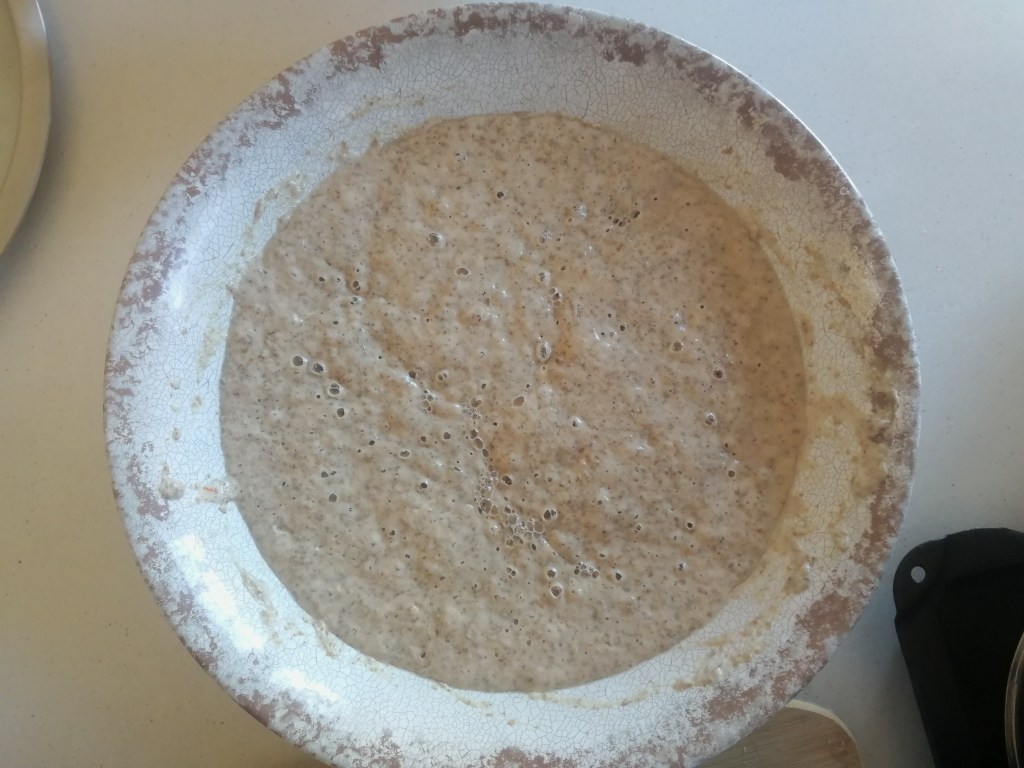
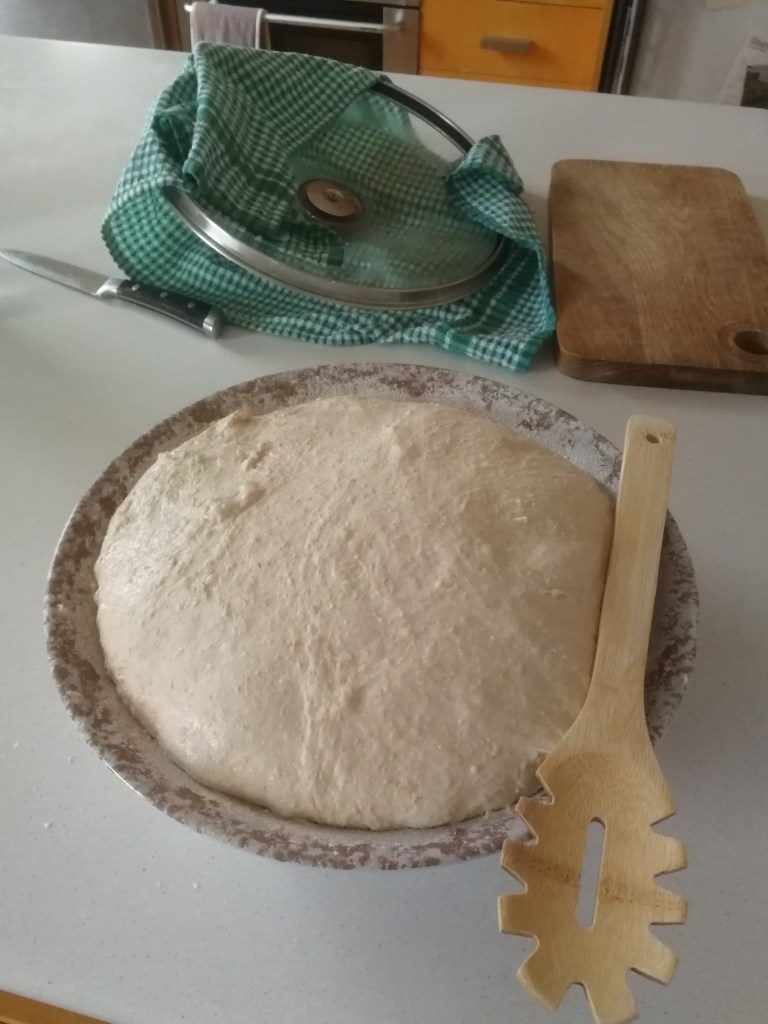
The poolish.Dissole all the yeast in 350g of lukewarm tap (drinking) water. Then add 350g of wholemeal flour and mix gently until you have a mass, a blob, of water and flour. If you have doubts about how to do the mixing in practice: don’t worry, it’s super simple. Check how this YouTuber does it (consider only the mixing part). Now cover it with a plastic film or a lid (always cover your dough) and leave it to rest at least overnight. If the temperature of your house is warm, it will be enough, if it is rather cold, it might take more. It should feature bubbles on its surface, as in the picture below. If you are not feeling confident that the poolish is ready, try the float test.
the poolish is ready
The actual dough. Add the rest of the ingredients (not the salt yet) and form the your actual dough. Let’s see how. Put your poolish in a big bowl (it might be already in one) and add 1/3 of the remaining flour (which will be a mix of wholemeal and Manitoba) and about 1/3 of the remaining water. Now mix and repeat until all the flour and almost all the water have been added. In the bit of water you kept aside, add all your 20g of salt. Don’t do anything with this salty water yet. You can get indications on how to mix from this video (from minute 1:47).
Autolysis. Have breakfast while your dough rests for minimum 20 minutes (max 1h). This will “automatically” create some structure within your dough, in what is a kind of self-kneading process. After the 20 minutes have passed, add the salty water and gently work the dough until the water is fully absorbed by the dough.
The folds. This recipe does not involve actively kneading, but rather helping the dough “self-kneading”, gaining structure progressively. If you are in lockdown, maybe you can fold the dough as shown below every 45 minutes or so for 3 times. If you have to go to work or don’t want to be harassed, just let the dough rest for 8 hours and do the folding after that. To see how to fold, check how it is done in this video, it’s super easy. Each time you repeat the procedure, you will feel the dough getting more supple and elastic, more stretchable. It is gaining the structure that will allow it to trap air inside (produced by the yeast) and to form “the bubbles”. If you have chosen the lockdown option, let the dough rest for 8 hours after the third cycle of folding.
Your pre-lamination dough.
The lamination. Now, this is an interesting passage that I have introduced only recently. It is very effective in giving additional structure to the dough and spreading the bubbles evenly. I learnt how to do it by watching this video. They add ingredients while laminating, but you don’t have to and if you are following my recipe you shouldn’t. After you have completed this step, leave the dough on the table for about 30-45 minutes.
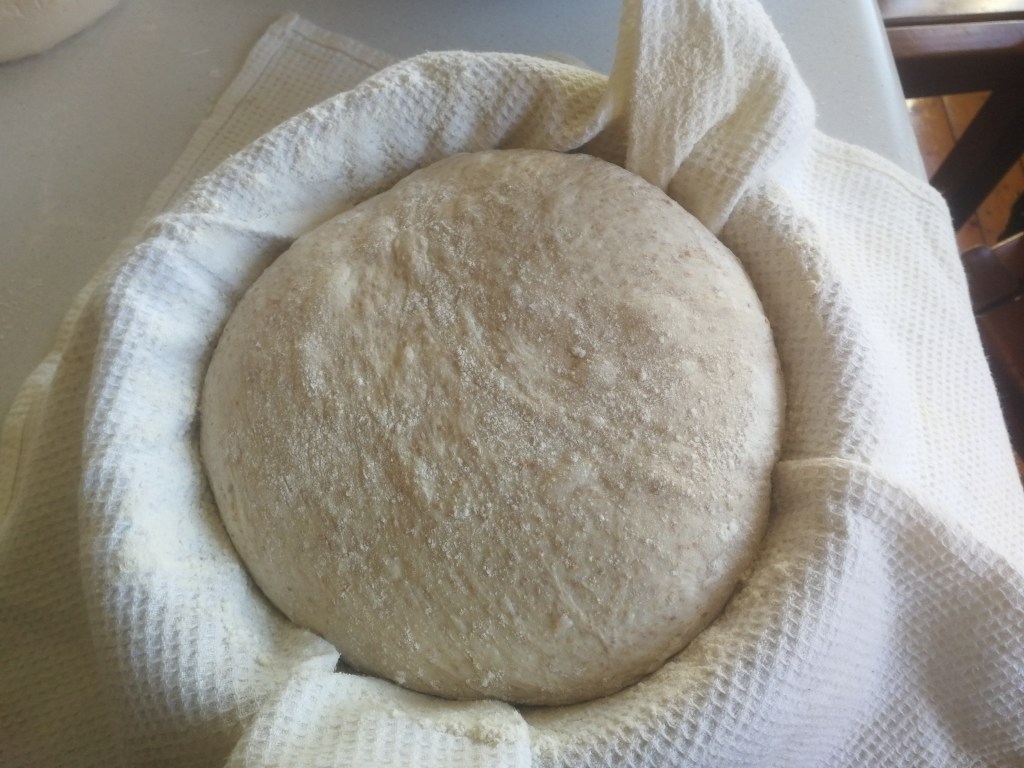
The formation. It is time to work the dough for the last time. Shape it in a boule (a round loaf) using this technique. Then grab a clean and dry towel, put it (wide open) in a bowl and cover it with a generous amount of flour. Now place your nice and round dough into it and dust it with flour at the top too. Cover the dough with the corners of the towel and put it in the fridge (proofing phase). It will stay there at least 30 minutes, the minimal amount of time to make it cold.
The dough is ready for proofing.
The scoring. Leave the dough on the table while your oven gets to 250 degrees (Celsius). When the oven is ready: (i) create tension in the dough, as shown here (as the dough has relaxed a bit since the time you shaped it); (ii) score it, using your sharpest knife, as shown here; (iii) generate steam in the oven. About point (iii), I usually do as shown here, which entails pouring water on a hot tray at the bottom of the oven.
The baking. The loaf will bake for 15 minutes at 250 degrees (static oven, often called bake, or classic bake, mode). Then you will open the oven, remove the steam-generating tray, lower the temperature to 180 (200 max) degrees and let it bake.
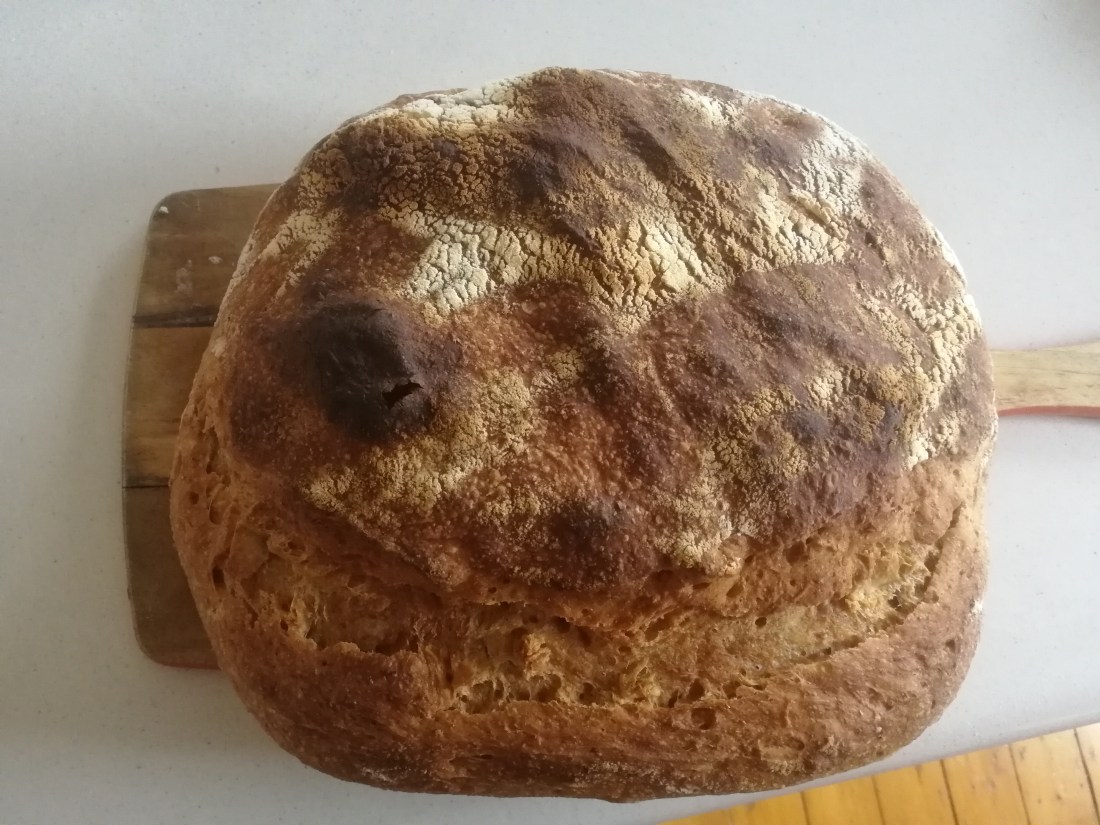
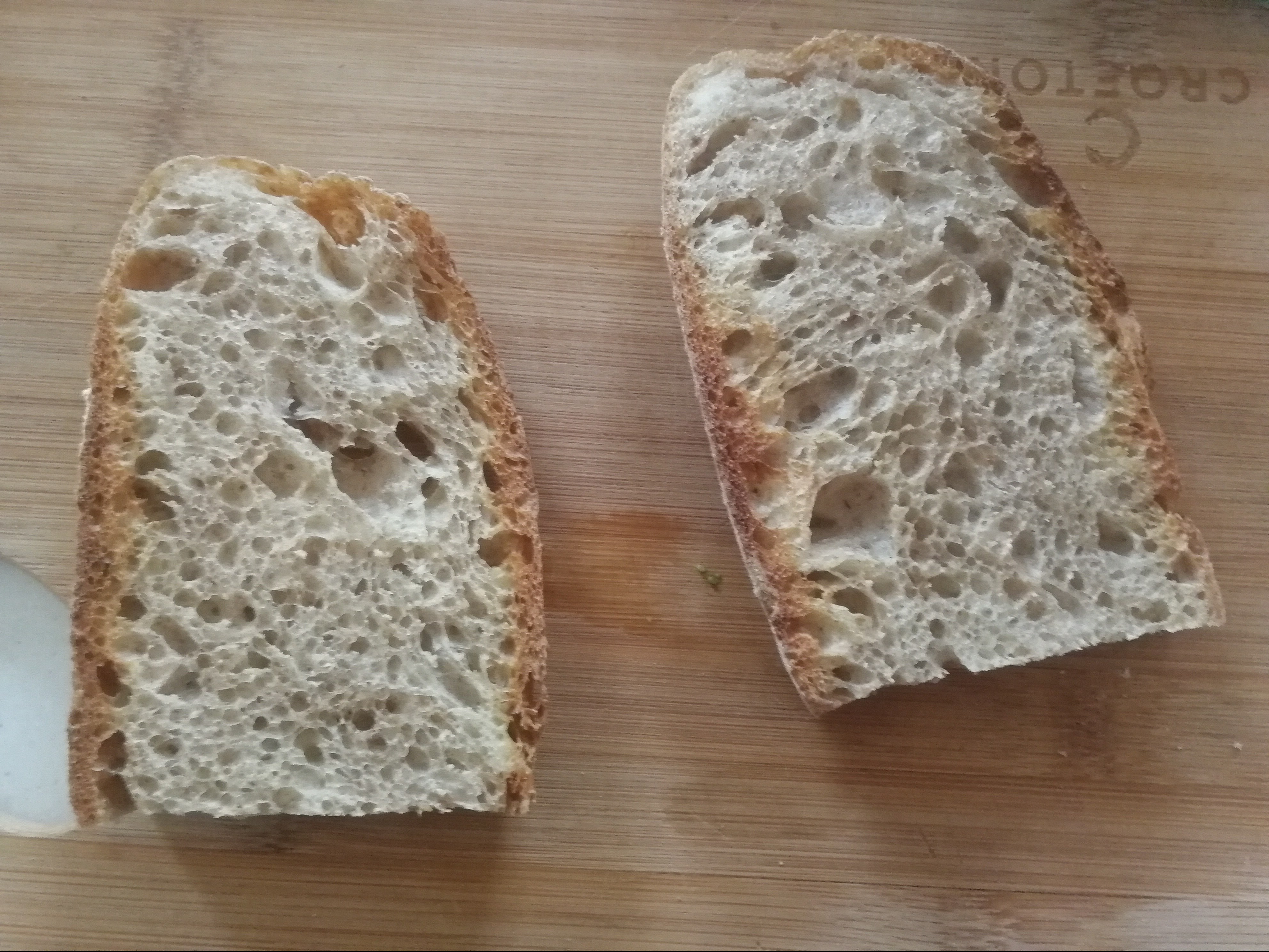
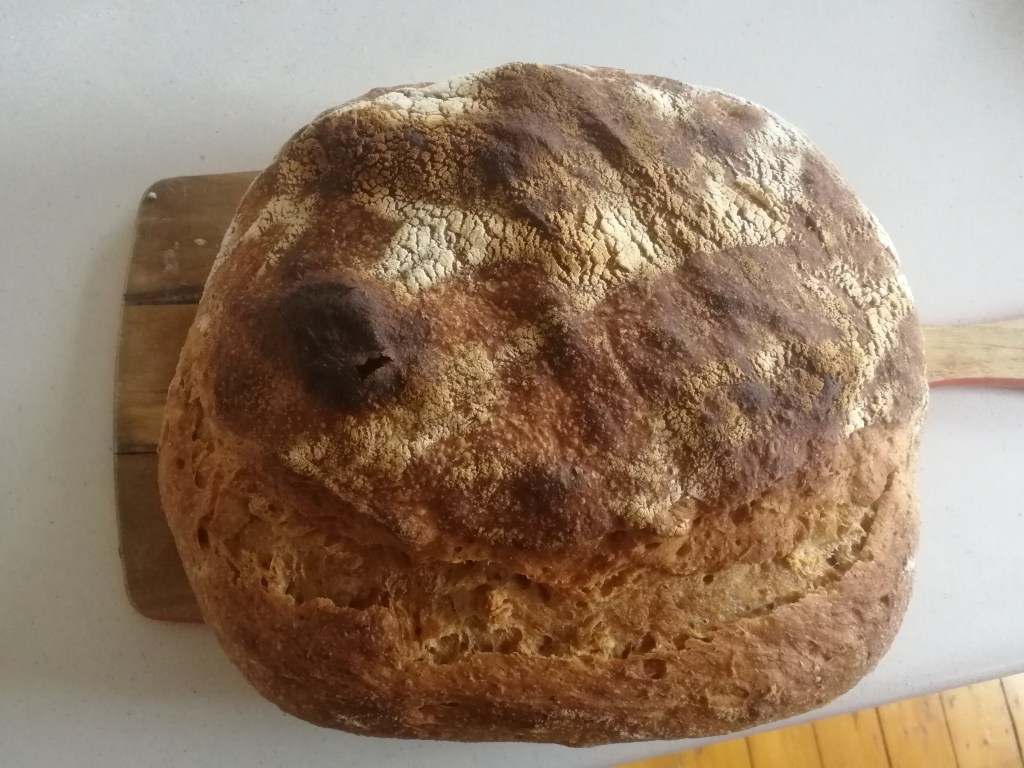
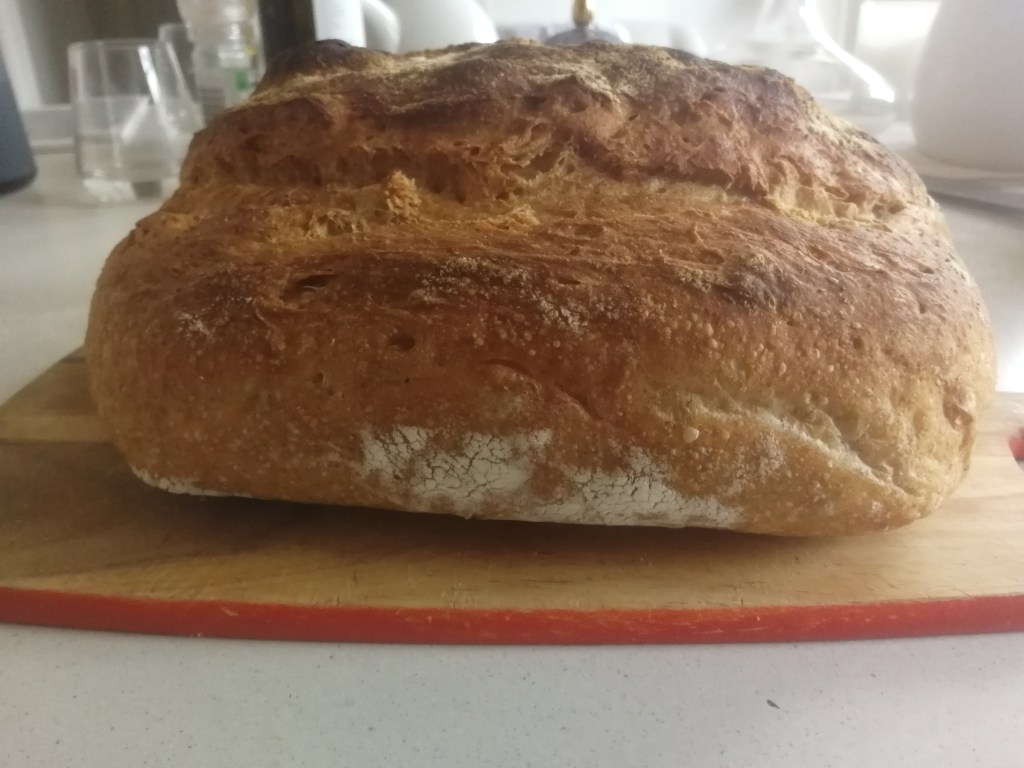
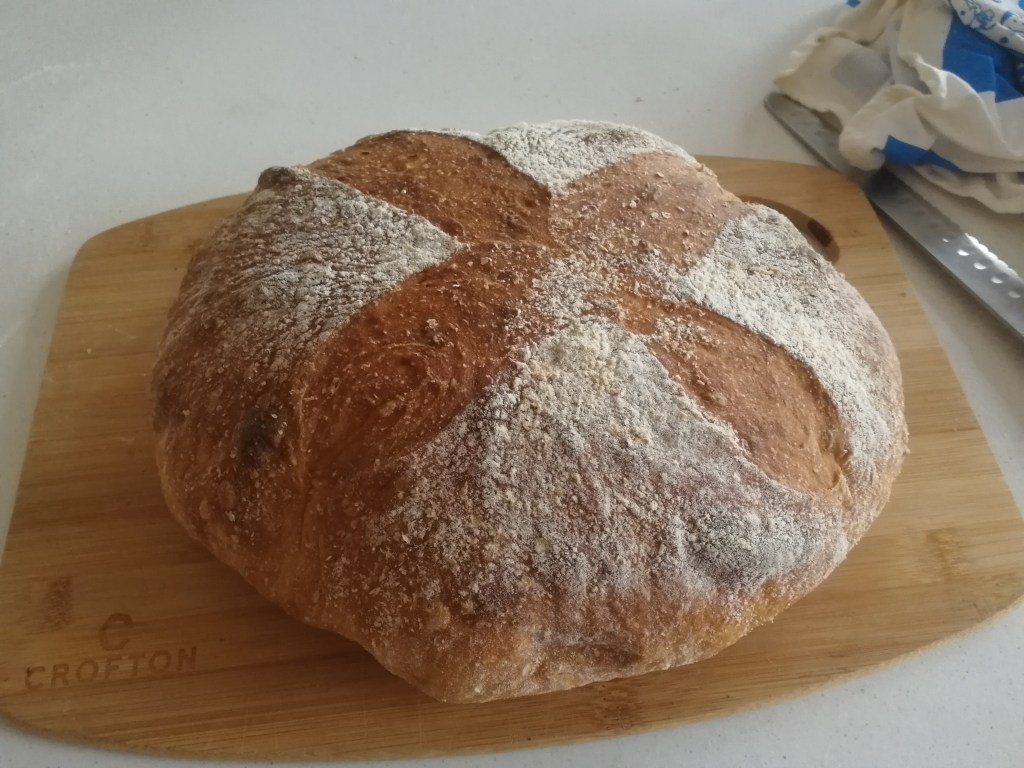
Ta-dà. You can now remove the loaf from the oven, and let it cool down on a grill for 4 hours. I let it cool overnight and try it first thing in the morning. As a grill I use my gas cooktop (obviously not turned on). Congratulations! See some results below.

 Italo's Kitchen